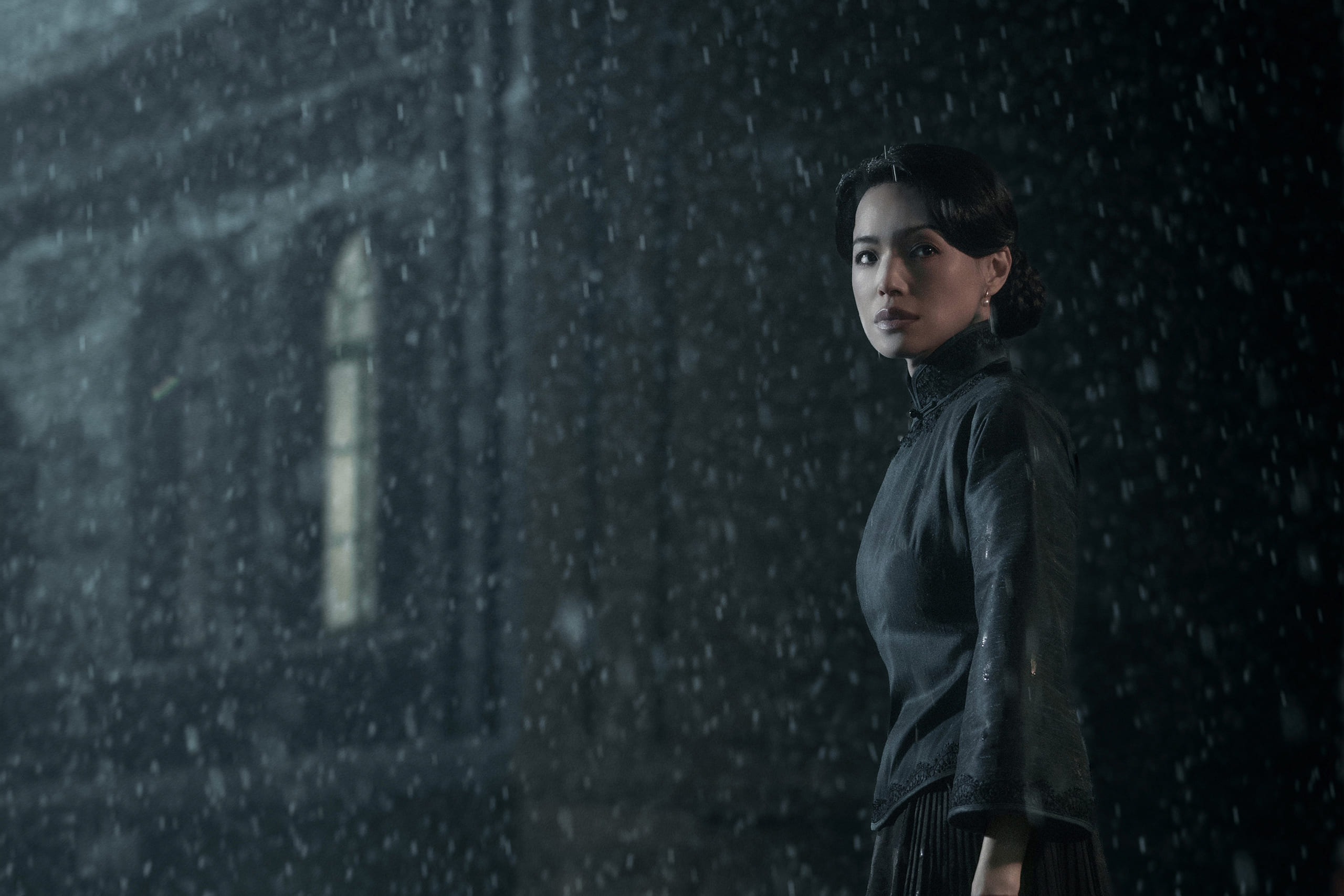
In a world where humanity has given up dreaming, one being remains captivated by the illusions of vanishing dreams. The monster, lost in wandering through its unrestrained reverie, convulsively clings to visions that no one else can see – until one woman appears. Endowed with the rare power to recognize these illusions for what they are, she consciously enters the monster’s dreams, determined to discover the truth hidden in their fabric. Chinese director Bi Gan continues his years-long audiovisual exploration of the interspace between the real and the imaginary. In his latest film, he takes us on an emotional odyssey that unfolds through poetic scenes imbued with imagination and speculation, in which memory and technology unite and merge.
The structure of the multi-part experimental epic is anchored around time travel and cycles of reincarnation, during which a certain “Phantasmer” sacrifices his immortality by choosing to continue dreaming (the dream being an allegory for the film) while “The Big Other” attempts to awaken him in order to make time linear. Named after a Lacanian psychoanalytic concept, she acts as the guardian of symbolic order and reality in a world permeated with artificial illusions.
Resurrection systematically plays with the film form, pushing the boundaries of film language and our powers of understanding. The phantasmagoric logic of a dream unfolds through six chapters, or five chapters and an overture shot in the manner of a silent movie. Each chapter represents a specific period of film history and one of the five senses (with the addition of the intuitive sixth sense, the wisdom of the body or interoception). Bi Gan connects them and maps them through the history of China during the last millennium, culminating in the merging of the cruelty of the new capitalism and the old political conformity. This monumental work stylistically evokes and mélanges masterpieces of film art from Murnau’s Nosferatu (1922) through Welles’s The Lady from Shanghai (1947) to the neon noir inspired by the films of Wong Kar-wai that takes place on New Year’s Eve in 1999 and is shot in one spectacular shot. A post-apocalyptic anthology about memory and an extravagant ode to film art and the art of surrender, through a meandering story about a rebellious dreamer, it asks the question of who dreams of whom and invokes Borges’ mysterious words: “Man imagines to himself that he is an image; an image that imagines to itself that it is reality.” It remains unclear whether the dreamer’s shapeshifting and incarnation of various subterranean characters brings about resurrection and meaningful transformation, or whether it is a matter of being lost in the incoherent and violent wilderness of cosmic existence and its astral planes. Or perhaps it is just a cheap illusion, a shoddy film trick, a synthetic pleasure in the flickering exchange of images. It is up to each viewer-dreamer to judge for themselves.


Trailer
Awards
- Jury Special Prize Cannes Film Festival 2025
- Film of Merit, Filmmaker of the Year Shanghai Film Critics Awards 2025
- Artistic Contribution Award Busan Int'l Film Festival 2025
- Special Prize of the Jury Istanbul Film Festival 2026
Screening schedule
- Kino Kinoteka