This program comprises two television documentaries that Heiny Srour made in the later phase of her filmmaking, when the revolutionary period of Third Cinema gave way to the advent of the era of neoliberalism. Yet Srour remains consistent in her commitment to decolonized feminist cinema grounded in the principles of militant cinema, bringing together the politics of collaboration and an unwavering anti-colonial ethos.
In the long years of war against France and the U.S., Vietnamese women fought alongside men as equals. Women such as Madam Binh, who negotiated with Henry Kissinger at the Paris Peace Accords, and later became Vice President of Vietnam, and Mrs. Nguyen Thi Dinh, general and deputy commander of the Vietcong forces, reached the highest positions of power. But 30 years after the signing of the peace agreement, the revival of Confucianism and the spread of market forces are conspiring to relegate women once again to the role of second class citizens. This film looks at what happened to Mrs. Binh and Mrs. Dinh and three other women since the war.
Kim Lai was 17 in 1965 when she captured an American pilot twice her size and the newspaper photograph of them was circulated around the world. Vo Thi Thang was also the subject of a famous picture. Sentenced to 20 years in jail by the South Vietnamese government for her part in the Tet offensive, her unrepentant smile was captured by photographers. Dr. Duong Quynh Hoa, Shadow Minister of Health in the provisional government, became Deputy Minister of Health for two years after the war until she became disillusioned. Vietnamese women overcame seemingly insurmountable odds in wartime. Their peacetime challenge is to rise above centuries of obedience and self-denial to build their own and their country’s future.


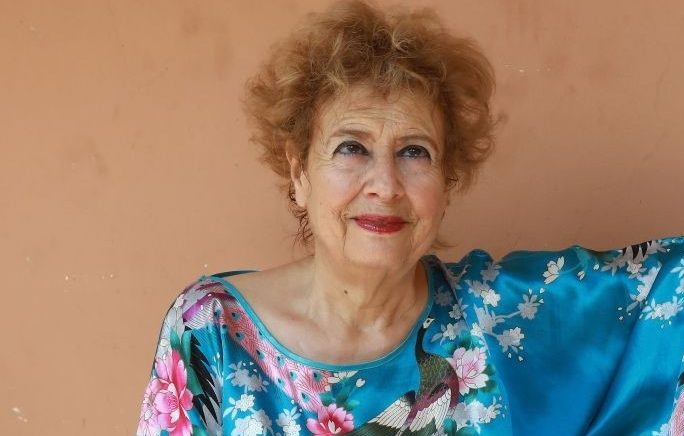
Heiny Srour
Born in 1945 in Beirut, studied Sociology at the French University of Beirut (Ecole Supérieure des Lettres) and went on to study Social Anthropology at the Sorbonne in Paris, where she was a student of both Marxist sociologist Maxime Rodinson and anthropologist filmmaker Jean Rouch. In 1969, while pursuing a PhD on the status of Lebanese and Arab women and working as a journalist for AfricAsia magazine, she discovered the struggle of the Popular Front for the Liberation of the Occupied Arabian Gulf, which led an uprising in the province of Dhofar against the British-backed Sultan of Oman. Determined to make a film about this feminist movement, she spent two years doing intensive research and finding the necessary funds before setting out to Dhofar. From the Yemeni border, Heiny Srour and her team crossed 500 miles of desert and mountains by foot, under bombardment by the British Royal Air Force, to reach the combat zone and record the only document shot deep inside the Liberated Area. The Hour of Liberation was completed in 1974 and selected at Cannes Film Festival, making Srour the first woman from the Third World to be selected at the prestigious international festival. Including four years of restoration, this documentary took, all in all, ten years of her life. It took her six years to achieve her next film, Leila and the Wolves (1984), in which she unveiled the hidden histories of women in struggle, in particular in Palestine and Lebanon, by weaving an aesthetically and politically ambitious tableau of history, folklore, myth and archival footage. In her words: “Why shouldn’t women be ambitious? Because men only want women to exclusively deal with women’s issues like home, family and so on, they want to ghettoize us. I resent this. We should deal with the public affairs and political issues too.” Since initiating a feminist study group in Lebanon in the early 1960s, Heiny Srour has been vocal about the position of women, in particular in Arab societies. She has written and spoken extensively about the image and role of women in Arab cinema. In 1978, along with Tunisian filmmaker Selma Baccar and Egyptian film historian Magda Wassef, she co-authored a manifesto ‘For the Self-Expression of the Arab Woman’, remaining passionately active in her feminist advocacy to this day. More recently, she shot a film in Vietnam (Rising Above: Women of Vietnam, 1995) and was the only filmmaker to film Egyptian protest singer Sheikh Imam in his home and neighbourhood (The Singing Sheikh, 1991).
Screening schedule
- Dokukino KIC