Entering the cinematic world of Noor Abed entails an encounter with a space in which image, body and landscape cannot be separated from modes of narration. From the outset, it becomes evident that her works are shaped within the tension that Edward Said describes as the struggle for the “permission to narrate.” This is a condition in which the right to tell one’s story must be continually reasserted, often against discursive constraints that determine what Palestine is, how it may be seen, and how it may be experienced. Within this framework, film ceases to function as a medium of representation and instead becomes a site where narratives are produced. What Anna Ball describes as the need to hear “the words under the words” takes on a concrete visual form here.
The images in Abed’s films open a space in which alternative voices emerge, voices that remain obscured behind reductive stereotypes and polemics. The viewer is thus confronted with multiple cinematic layers that resist reduction to a singular interpretation. Such an approach is closely tied to the complex principles of Palestinian cultural production, which Ball identifies as a field in which “multi-layered and polyphonic” forms of identity take shape. In Abed’s films, this polyphony unfolds through the relations between bodies and landscape, through the rhythm of collective movement, and through the caesuras that arise between image and sound. The films sustain a condition of openness in which meaning continuously shifts and eludes capture.
Her work can therefore be read in continuity with what Frantz Fanon terms a “literature of combat.” Cultural production here operates as a means of articulating suppressed experiences while also shaping collective consciousness. At the same time, it is important to note that these films do not advance an explicit political thesis. Their political force resides in the very act of creating a space in which what has been erased, suppressed, or marginalized can appear.
The film Our Songs Were Ready for All Wars to Come develops a visual language in which collective movement emerges as a form of knowledge that resists full rational articulation. Bodies gather, disperse, and reassemble into a shared rhythm, while space is not merely a neutral backdrop but an active element participating in the formation of relations. It introduces its own temporality and opens fissures within linear time. It is precisely here that the necessity of “re-narrating” Palestinian culture becomes visible, as Ball suggests, in ways that reveal its complexity.
Within this process, the postcolonial perspective does not appear as a stable theoretical framework. Palestine, as Ball indicates, exists within a “synchronicity of the colonial and the postcolonial,” a space that demands constant negotiation of terms. This ambivalence is reflected in Abed’s cinematic language. Her images do not confirm pre-existing categories; they unsettle them, opening a space in which colonial power relations intersect with internal social hierarchies.
The introduction of a gender-conscious perspective further shifts how these relations can be read. Postcolonial feminism enables the articulation of experiences that remain outside dominant narratives, whether shaped by colonial or patriarchal structures. In Abed’s films, this becomes evident in the way (female) bodies enter the frame, in how they are dressed and how they act, more precisely in how collective action evades fixed divisions of roles. As a result, female presence—both visual and sonic—becomes, alongside landscape, an active principle in the organization of the image. The camera does not claim totality; it remains within the relations it constructs, drawing the viewer into a network that offers no final resolution.
It is also necessary to address the gendered structure of the national imaginary, as it is precisely this structure that, in Abed’s films, shifts from static allegory into movement, voice, and rhythm. A postcolonial feminist reading of Palestinian culture (though certainly not limited to it) suggests that the nation is often imagined as a community of birth, belonging, and origin. The very etymology of the word “nation,” derived from the Latin natio, meaning birth, people, tribe, or origin—stemming from the verb nasci, “to be born”—points to a conception grounded in shared origin. In this sense, as the postcolonial feminist theorist Anne McClintock argues, the nation is inscribed within a symbolic order of family, maternity, and fertility. In the Arabic expression al-watan al-umm, the homeland as mother, this association becomes even more pronounced: the land is imagined as source, body, origin, protection, and return.
Such symbolic power attributed to the feminine figure within national narratives does not translate into actual social power for women. Nira Yuval-Davis has shown that women frequently signify “the collective unity, honour, and raison d’être” of the nation, while remaining excluded from the political “we,” positioned as objects rather than subjects. Woman thus becomes the image of the nation, the bearer of its honour, its biological and cultural reproducer, yet without control over the terms in which the nation is narrated. For this reason, in the Palestinian context it becomes crucial to ask how female bodies appear in film: do they remain allegories of land, loss, and belonging, or do they produce a different regime of visibility?
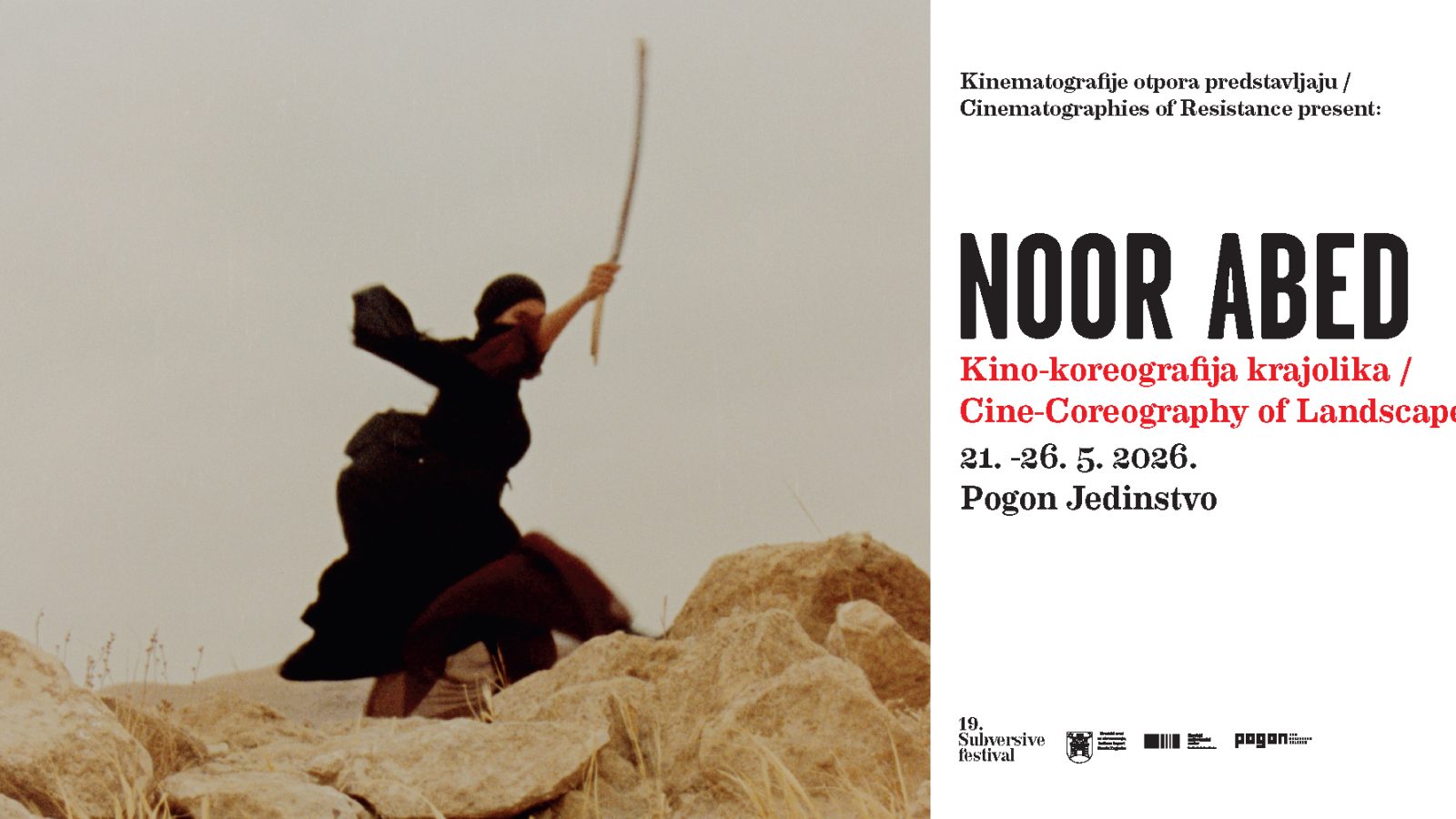
In Abed’s films, women sing, dance, and move through the landscape; they introduce rhythm, shift and animate the desert, in short, they organize space. Their presence does not exhaust itself within the iconography of “woman as nation,” even though that historical weight cannot be erased from viewing. In Our Songs Were Ready for All Wars to Come, female voices and bodies do not appear merely as signs of a wounded community. They constitute community through performance: through song, lament, sound, repetition, touch, circular movement, and the transmission of motifs and rhythms. The national can thus be understood as a process of gathering, as a collectivity that emerges within performative time.
For this reason, Ball’s call to attend to “the words under the words” can also be extended to the act of viewing Abed’s films. Beneath the surface of folkloric, ritual, or archaic motifs, a more complex operation of the image unfolds. Song and dance under the open sky do not function as decorative elements of cultural identity. They operate as modes of memory, forms of transmission, and means through which a community sustains itself under conditions of historical rupture.
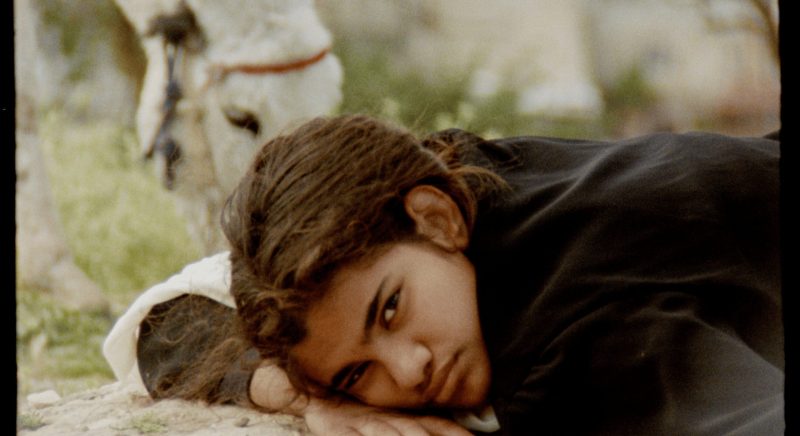
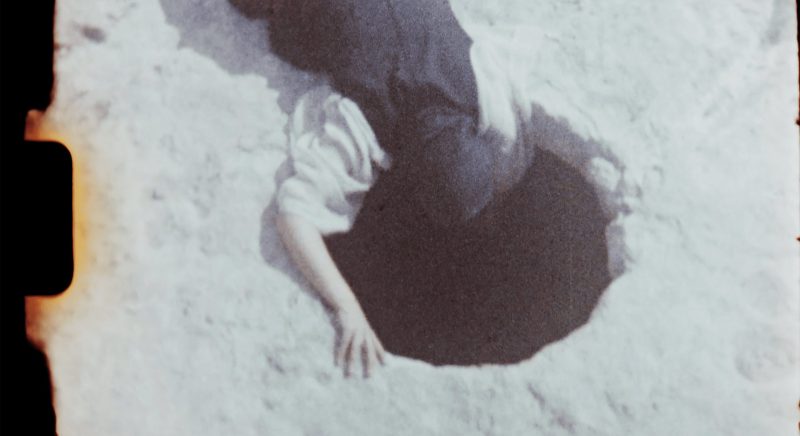
In the barren landscape of A Night We Held Between, a group of people, donkeys, caves, wells, light entering darkness and darkness overtaking the frame do not constitute an exotic image of the “Orient.” Instead, they enter into tension with a long history of Orientalist and colonial gazes that have imagined Palestine—and the Middle East more broadly—as a space of desire, conquest, fertility, and patriarchal possession.
It is precisely here that the sensitivity of Abed’s cinematic language emerges. Mediterranean and Middle Eastern motifs, biblical references, barren land, animals, caves, rituals, and songs could easily be read as a series of recognizable signs of a “sacred” or “archaic” landscape. Abed, however, slows them down, sonifies them, renders them through 16mm texture, disperses them, and introduces an atmosphere of unease. Landscapes appear as digitally processed fractures, as memory and geopolitical fissures in which the historical, the mythical, and the everyday coexist without resolution.
Particularly striking is the song sung in the first person by a woman, ending with the line: “I will paint my teeth black because my beloved might return.” In this utterance, the body becomes a site of waiting, love, mourning, and possible return. The blackened teeth function as a small yet unsettlingly concrete sign: intimate, corporeal, visible in the mouth, somewhere between a grimace and a smile. The female voice here does not operate as a general allegory of the homeland. It introduces a particular, vulnerable and material dimension of memory that resists being translated into a national metaphor.
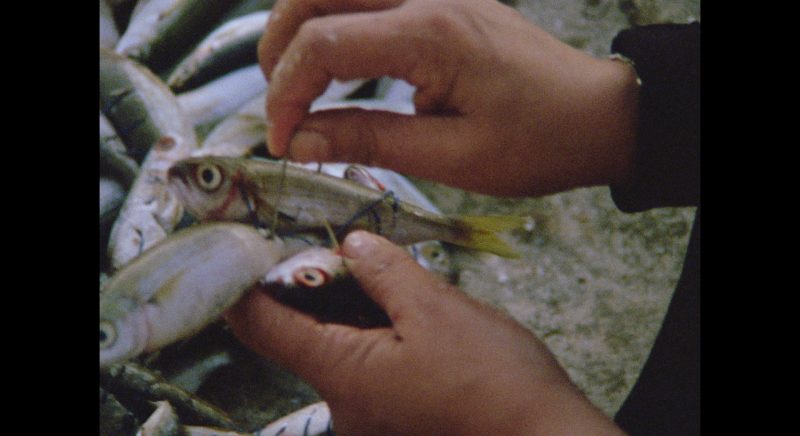
The same applies to the photographs of warriors passed between an old man and a boy. The camera, rather than showing their faces, focuses on their hands. This transfer of images—from hand to hand, from old age to youth, from a past time to one yet to come—introduces another mode of inheritance. The warrior is not monumentalized as a heroic figure. He appears as a photograph, as an object, as a trace or a memory that demands to be touched.
At this moment, the film approaches what Said describes as the right of Palestinians to “look, scrutinize, assess, judge.” Abed’s protagonists are not objects of an external gaze. They appear instead as those who, within the landscape, preserve, rearrange, recognize, and choreograph their own images, rituals, movements, and voices.
1. Anna Ball, Palestinian Literature and Film in Postcolonial Feminist Perspective (London: Routledge, 2012).
2. Frantz Fanon, The Wretched of the Earth (New York: Grove Press, 1963).
3. Edward W. Said, After the Last Sky: Palestinian Lives, photographs by Jean Mohr (New York: Pantheon Books, 1986).
Authors: Dina Pokrajac i Leila Topić